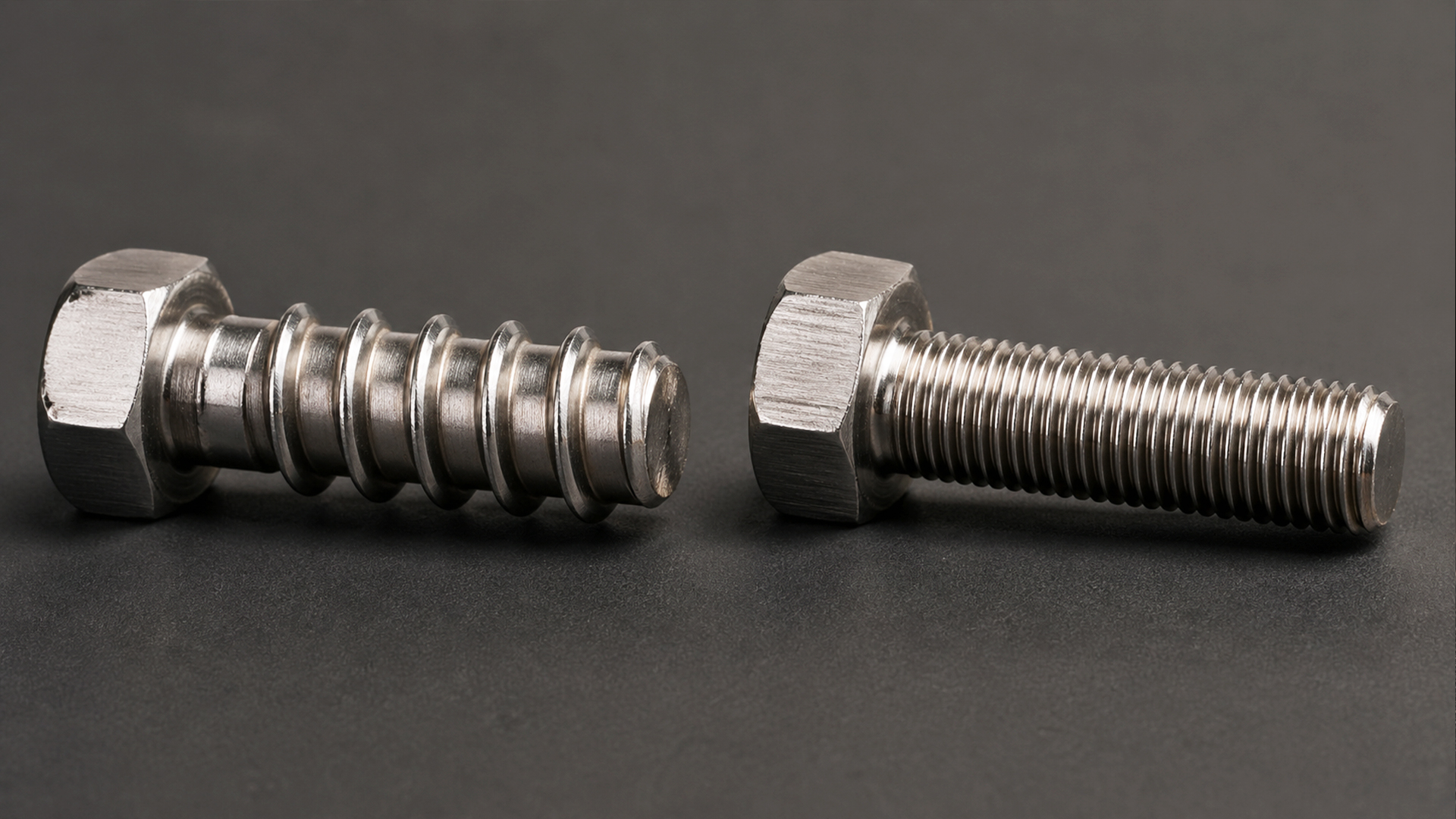
Fine Thread vs. Coarse Thread: What is the difference?
Anyone reading taps, screws or technical drawings will quickly encounter designations such as M10 or M10 x 1.25. Behind this is not a detail reserved for specialists, but a difference that influences assembly speed, adjustability, vibration behavior and suitability for specific materials or component geometries. In metric ISO threads, coarse threads and fine threads are standardized. The basic profile remains the same; the key difference lies in the pitch.
What is pitch?
Pitch describes the distance from one thread crest to the next. More precisely, it indicates how far a screw moves into the mating thread during one complete rotation.
For a thread M10 x 1.5, for example, the pitch is 1.5 mm. This means that when the screw completes one full 360-degree rotation, it moves forward by 1.5 mm. With a thread M10 x 1.0, this distance is only 1.0 mm. The screw therefore moves less far per rotation, but can be adjusted more precisely.
With inch threads, the pitch is often not stated directly in millimetres, but by using TPI. TPI stands for threads per inch. One inch equals 25.4 mm. The higher the TPI value, the more thread turns there are over a length of one inch – and the finer the thread.
You can calculate the pitch of an inch thread as follows:
Pitch in mm = 25.4 ÷ TPI
An example:
A thread with 20 TPI has a pitch of:
25.4 ÷ 20 = 1.27 mm
This means that the screw moves forward by 1.27 mm during one complete rotation. With 10 TPI, by contrast, the pitch would be 2.54 mm. The thread is therefore coarser because there are fewer thread turns per inch.
This is exactly where the most important difference between coarse threads and fine threads lies. With coarse threads, the pitch is larger and is defined as the standard for each nominal size. With fine threads, the pitch is smaller. This means that the thread turns are closer together, and the pitch is additionally stated in the designation.


What is a coarse thread?
In the metric ISO system, the coarse thread is the standard version. The thread has a flank angle of 60 degrees, and in Europe it is typically used as an ISO coarse thread according to DIN 13-1. The designation usually only contains the M with the nominal diameter, for example M10. The standard pitch is firmly assigned to this. In common tables, M10 as a coarse thread has a pitch of 1.5 mm.
This makes coarse threads particularly straightforward in practice. If a drawing only shows M8, M10 or M12, the corresponding metric coarse thread is usually meant. The pitch does not have to be specified separately because it belongs to the respective nominal size.
What is a fine thread?
A fine thread has a smaller pitch than a coarse thread with the same outside diameter. This means that the thread turns are closer together, and the pitch is included in the designation, for example M10 x 1.25 or M10 x 1.0. In Europe, DIN 13-2 to DIN 13-11 are commonly used for metric fine threads.
The nominal diameter remains the same. An M10 coarse thread and an M10 x 1 fine thread therefore both have the nominal diameter M10. The difference lies in the pitch. This is exactly why the designation “M10” alone is not sufficient for fine threads.
The technical difference in practice
Because the pitch is smaller with a fine thread, more thread turns fit within the same length. The outside diameter and 60-degree flank angle remain the same for metric ISO threads, but the thread depth becomes smaller and the core diameter becomes larger. This is exactly why fine threads often have a larger load-bearing cross-section with the same nominal diameter and therefore better tensile or shear properties.
The smaller lead angle has two further practical effects: fine threads allow more precise adjustment and are less prone to loosening by themselves under vibration because their self-locking effect is higher. This is exactly why they are often mentioned for set screws, precise adjustments or vibration-critical applications.
Coarse threads, on the other hand, show their strengths in robust everyday applications. Thanks to the larger pitch, assembly is faster, the thread is less sensitive to damage, contamination and seizing, and in softer or more brittle materials a coarser profile is often the more robust choice. This is why the coarse thread is considered the standard in many applications unless there is a clear reason to use a fine thread.
When does a fine thread make sense?
Fine threads are particularly useful when precise adjustment is required, when components are thin-walled or when as much load-bearing cross-section as possible needs to be retained with the same nominal diameter. They are also often preferred in harder materials and in applications with an increased tendency toward vibration.
Typical areas of application include, for example:
- Set screws and adjustment connections, when small movements need to be precisely controlled
- Thin-walled components, when only little material is available
- Precision connections, where finer adjustment is important
- Hydraulic components, when compact and load-bearing connections are required
- Vibration-loaded applications, where the screw connection should not loosen easily
When is a coarse thread useful?
Coarse threads are usually the better choice for general screw connections, fast assembly, service cases involving dirt or corrosion, and softer or more brittle materials. In many standard applications, this is precisely why coarse threads appear first on drawings, in parts lists or in purchasing.
Typical areas of application include, for example:
- General machine screw connections, where no special fine adjustment is required
- Housings and covers, which need to be securely fastened
- Brackets and fixtures, where simple assembly is important
- Standard components, where good availability is important
- Repairs and maintenance, when a common thread size is required
What does this mean for choosing the right tap?
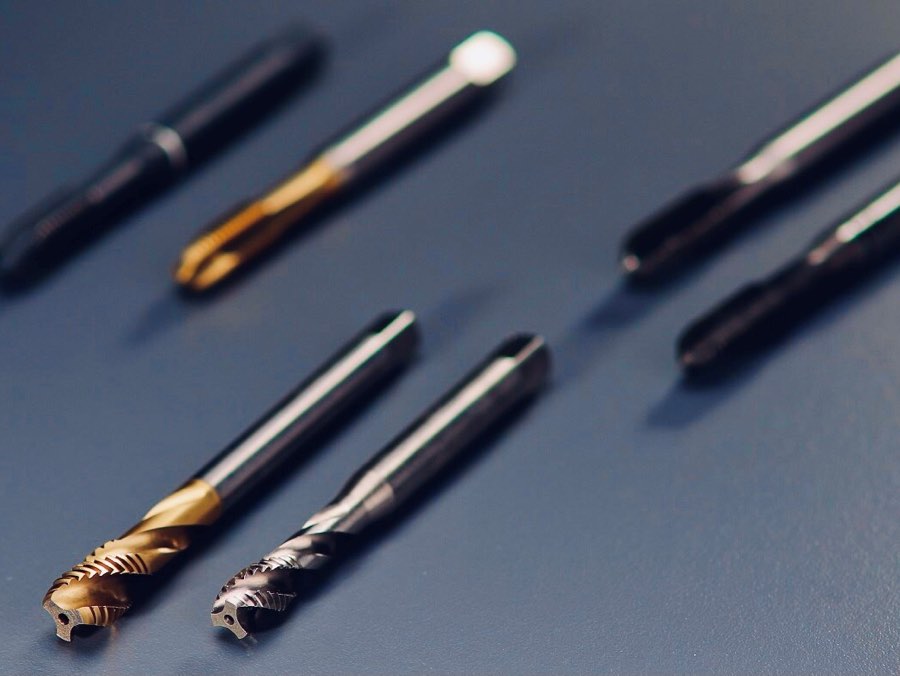
In practice, this means that not every metric thread is automatically the same. The decisive factor is always whether it is a coarse thread or a fine thread, because this determines the correct pitch and therefore also the right tap. This is exactly where VÖLKEL offers the right solution. With the corresponding range for metric coarse threads and metric fine threads, you get the right tools for both thread types for clean and standard-compliant machining.
This is especially important in everyday work because confusing coarse threads and fine threads can quickly lead to dimensional deviations, poor fit or unusable threads. With the right VÖLKEL taps for both standard ranges, this can be reliably avoided. This allows you to cut exactly the thread required for the application – whether as a robust standard solution with a coarse thread or as a more precise variant with a fine thread.
Conclusion
Fine threads and coarse threads do not differ in their basic system, but mainly in their pitch. Fine threads offer greater precision, higher self-locking and often a larger load-bearing cross-section with the same nominal diameter. Coarse threads stand out thanks to faster assembly, greater robustness and their suitability as the standard solution for many everyday applications.
Anyone selecting the right tap should therefore never look only at the nominal diameter, but always at the full thread designation. This is exactly where you can see whether it is a coarse thread or a fine thread – and which pitch the tool really has to cut.