
V-COIL Oxygen Sensor Thread Repair Kit
Damaged lambda / O2 sensor thread? Restore it permanently – directly on the exhaust.
Stripped or cross-threaded oxygen sensor bores are a common workshop problem. The V-COIL LS kits let you repair the M18×1.5 thread on the installed component – with a choice of wire or solid insert to suit the degree of damage.

What this kit helps you with
The V-COIL LS kits are purpose-built for oxygen and lambda sensor thread repair – covering the most common exhaust thread sizes.
Repair on the installed component
In many cases the repair can be carried out directly on the exhaust manifold or pipe – no removal required.
Special HexTap LS / LSN
Dedicated tap geometry for oxygen sensor threads – cuts a clean receiving thread even in confined exhaust environments.
Inconel X750 wire inserts
The wire insert LS is made from Inconel X750 – a nickel superalloy with outstanding heat and corrosion resistance for exhaust temperatures.
Solid insert option
The solid insert LS (19147) provides a bush-type repair for more heavily damaged bores where a wire insert alone is not sufficient.
M18×1.5 and M20×1.5
Kits available for both common oxygen sensor thread sizes to cover the majority of passenger cars and light commercial vehicles.
Avoid expensive replacements
Restore the thread instead of replacing the manifold, downpipe or catalytic converter housing.
The LS kit range – two repair approaches
Choose the kit that matches the condition of the damaged bore and the application requirements.
Oxygen sensor threads (lambda probe threads) are exposed to extreme heat cycles, vibration and corrosion. When the M18×1.5 or M20×1.5 thread in the exhaust manifold or pipe is stripped or corroded, the V-COIL LS system offers two proven repair paths:
- Wire Insert LS – Inconel X750 (Art.-No. 19149): A helical wire insert from Inconel X750, engineered for the extreme temperature and corrosion conditions at the exhaust. Installed with the HexTap LSN.
- Solid Insert LS (Art.-No. 19147): A bush-type solid insert for heavily damaged bores where additional wall material is needed. Installed with the HexTap LS.
Both variants restore a defined M18×1.5 (or M20×1.5) receiving thread for the oxygen sensor and allow refitting to the manufacturer's specified torque.
Kit variants at a glance
Three kit configurations covering both insert types and both thread sizes.
Starter Kit – Wire Insert LS (Inconel X750)
- Thread size: M18×1.5 or M20×1.5
- 5 wire inserts LS Inconel X750
- HexTap LSN
- Installation tool
Workshop Kit – Solid Insert LS
- Thread size: M18×1.5 or M20×1.5
- 10 solid inserts LS (19147)
- HexTap LS
- Installation tool
Professional Kit – Wire & Solid
- Thread size: M18×1.5 or M20×1.5
- Wire inserts LS Inconel X750 (19149)
- Solid inserts LS (19147)
- HexTap LS + LSN, installation tools
Repair process in moving pictures
The video demonstrates the complete procedure: from the damaged oxygen sensor bore to the finished, reinstalled sensor. Ideal to follow along directly at the vehicle.
Combine the video with the written steps below and the image sequence for a complete overview.
Step-by-step instructions
The following sequence describes the standard repair procedure. Always follow the vehicle manufacturer's specifications.
-
Remove the oxygen sensor and inspect the thread.
Carefully remove the lambda / O2 sensor. Inspect the bore to confirm whether the thread is stripped, corroded or cross-threaded – and select the appropriate insert type (wire or solid) based on the damage. -
Clean the bore and prepare the work area.
Remove carbon deposits, corrosion and debris from the bore and the surrounding area. Ensure chips can be removed cleanly during tapping. -
Cut the new receiving thread with HexTap LS or LSN.
Select the correct HexTap from the kit (LS for solid insert, LSN for wire insert). Cut the new receiving thread straight into the bore. Back off regularly to break chips – especially important in confined exhaust environments. -
Remove chips and clean the sealing area.
Carefully remove all chips and swarf from the thread and bore. No debris must remain that could enter the exhaust system. -
Install the insert.
For the wire insert LS (Inconel X750): wind the insert into the new thread using the installation tool until it sits flush or slightly below the surface, then break off the drive tang.
For the solid insert LS: press or thread the bush into the bore according to the kit instructions. -
Refit the oxygen sensor and check for leaks.
Refit the oxygen sensor with a new seal if required. Tighten to the vehicle manufacturer's torque specification. Start the engine and check for exhaust gas leaks at the sensor bore.
Note: The exact procedure can vary by vehicle type and kit version. If in doubt, contact a professional workshop or VÖLKEL technical support.
Safety & good practice
- Work only on a fully cooled exhaust system – risk of serious burns on hot components.
- Wear safety glasses and heat-resistant gloves throughout the repair.
- Use suitable cutting oil when tapping to reduce friction and improve thread quality.
- Always use a torque wrench when refitting the sensor to avoid overloading the new thread.
- Check the repair for exhaust leaks after the first warm-up cycle.
Visual guide: from damaged bore to finished repair
These images show the practical sequence – from the kit overview to the installed insert.
Kit overview
All components in one kit: HexTap LS / LSN, wire inserts LS Inconel X750, solid inserts LS and installation tools.
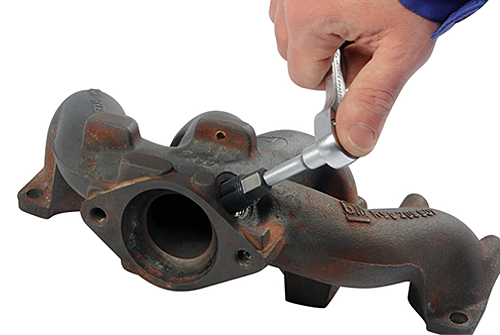
Cut the receiving thread
The HexTap LS or LSN cuts a clean, defined receiving thread into the damaged bore – ready for the insert.

Solid insert LS installed
The solid insert LS sits securely in the new thread, providing a robust M18×1.5 bore for the refitted oxygen sensor.
Technical & practical benefits
A specialist solution for one of the most demanding thread repair tasks in automotive service.
Extreme heat resistance
Inconel X750 wire inserts withstand the high temperatures typical of exhaust manifolds and downpipes where standard materials would fail.
Two insert options
Wire insert LS and solid insert LS cover different damage scenarios – choose the right approach for each job.
Repair without removing the exhaust
The HexTap LS is designed for direct access on the installed component, saving significant labour time in most applications.
Gas-tight result
A correctly repaired and correctly torqued sensor bore provides a gas-tight seal and restores correct sensor function.
Cost-efficient alternative
Repairing the thread instead of replacing a manifold, catalytic converter housing or entire exhaust section saves significant parts and labour costs.
Part of the V-COIL system
Complements the full V-COIL automotive thread repair range, including kits for oil drain, spark plug and general metric threads.
Frequently asked questions
Short answers to common questions – directly at the vehicle.
In many cases yes. The HexTap LS is designed for direct use on the installed component after the sensor has been removed. Accessibility depends on the vehicle – always check clearance before starting the repair.
Both restore a defined M18×1.5 thread. The wire insert LS (Inconel X750) is the standard choice for typical damage – it is heat-resistant and provides a reliable, durable thread. The solid insert LS is suited to more heavily damaged bores where additional material support is needed. Select based on the extent of damage and available wall thickness.
Inconel X750 is a nickel-based superalloy engineered for high-temperature and corrosion-resistant applications. At exhaust manifold temperatures, standard stainless steel would be insufficient. Inconel X750 maintains its mechanical properties across the full operating temperature range of the exhaust system.
Yes. The V-COIL LS kit range covers both M18×1.5 and M20×1.5 – the two most common oxygen sensor thread sizes. Check the kit designation when ordering to confirm the thread size.
After refitting the sensor and starting the engine, check for exhaust gas leaks at the sensor bore during the first warm-up cycle. Also verify that the sensor is reading correctly via the vehicle's diagnostic system. Re-check visually at the next service.