

VÖLKEL MBlue: The Blue Mamba for Tough Steels
Highly alloyed and tough steels, short-chipping stainless steels or alloyed tool steels: in these materials, tapping quickly becomes a demanding test for the tool. The VÖLKEL MBlue is now available specifically for these applications up to a tensile strength of 1,200 N/mm². This HSSE machine tap relies on two features that work together: a hard TiCN coating on the thread flanks and steam-treated flutes that retain the cutting fluid where cutting takes place.
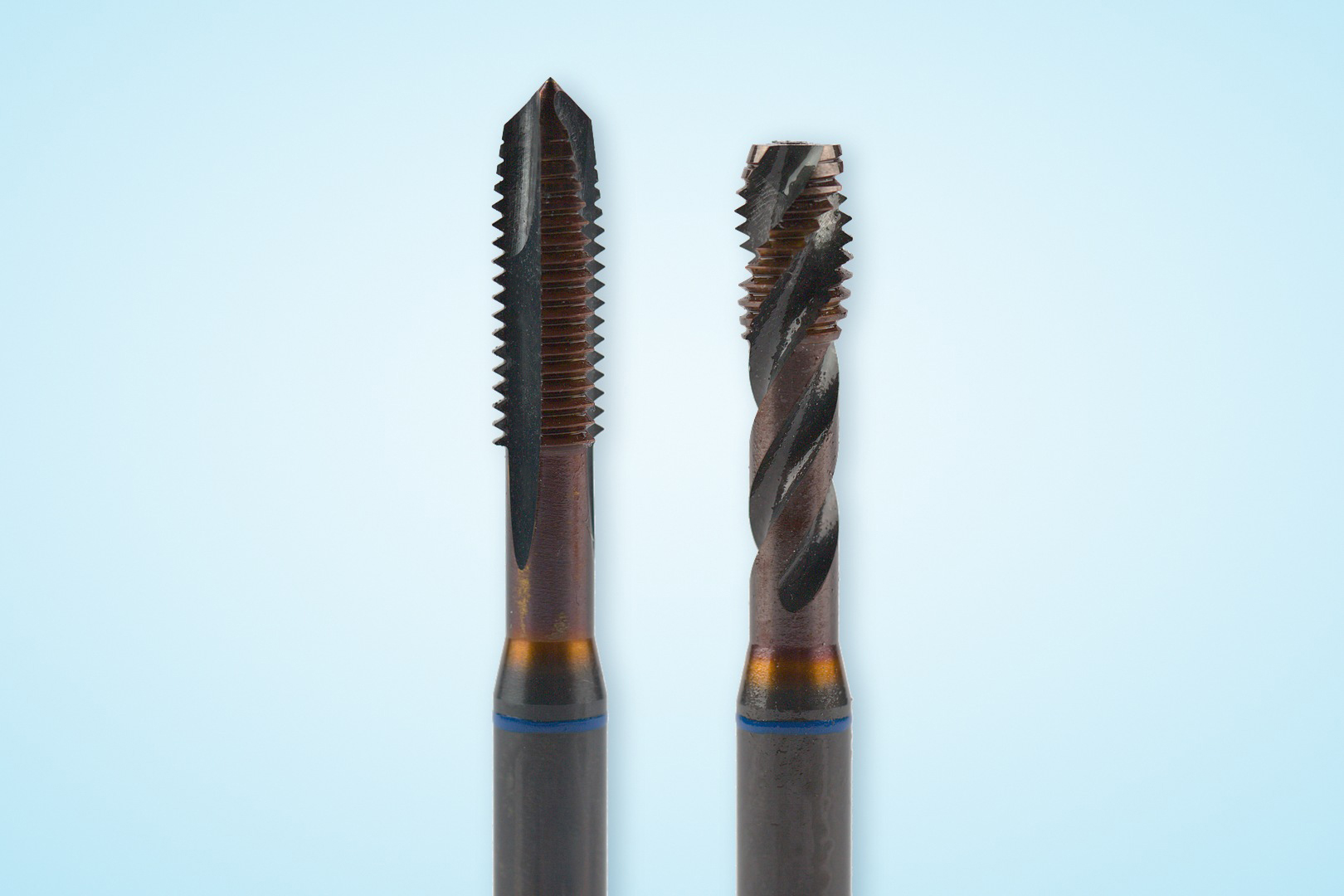
The MBlue belongs to the new Mamba series and is based on our BLUE RING machine tap. The blue ring on the shank therefore makes it instantly recognisable. It is available in Form B for through holes and Form C with a 39° right-hand helix for blind holes, each in sizes M3 to M20.
TiCN is a standard hard coating produced using the PVD process. It is less temperature-resistant than TiN or TiAlN. Despite its high hardness, it retains good toughness and is less brittle. With the MBlue, the flutes are steam-treated in an additional manufacturing step so that the cutting fluid quickly reaches the point where it is needed: the cutting edge.

What distinguishes the MBlue from a conventional machine tap?
The difference lies in the surface, specifically in two areas of the tool that perform different tasks.
The thread flanks are coated with titanium carbonitride (TiCN). The coating reaches a hardness of up to approximately 3,000 HV, making it harder and lower in friction than titanium nitride (TiN). It acts where a tap experiences the greatest loads in tough, wear-resistant materials: the flanks slide along the thread being produced throughout the cutting operation. The hard coating slows down wear, while the low friction reduces heat generation.
TiCN does, however, have a limitation: the coating can withstand only limited heat. A guideline maximum operating temperature is around 400 °C, or slightly higher depending on the coating structure. To maintain the coating’s effectiveness, the MBlue needs careful cooling and lubrication.
The flutes address precisely this limitation. We have steam-treated them in an additional manufacturing step to ensure a reliable and consistent lubricant supply. During steam treatment, the surface is treated with water vapour. This produces a black iron oxide layer to which the cutting fluid adheres much more effectively. The fluid therefore stays closer to the interface between tool and workpiece. This reduces friction and temperature peaks, protecting the coating precisely where TiCN is sensitive.
Which materials is the MBlue designed for?
The MBlue is designed for wear-resistant and tough materials up to a tensile strength of 1,200 N/mm². These include highly alloyed steels, tough short-chipping materials, short-chipping stainless steels and alloyed tool steels.
Each of these material groups places different demands on the tap:
- High strength and toughness increase cutting forces and, consequently, heat at the cutting edges and flanks.
- Alloyed tool steels contain hard carbides that have an abrasive effect on the cutting edges.
- Many stainless steels tend to adhere to the tool. This can lead to cold welding on the flanks.
The hard, low-friction TiCN coating and the well-adhering lubricant film address precisely these issues.
Pay attention to the term “short-chipping”. It refers to materials whose chips break into short pieces and can be reliably evacuated from the hole. More suitable tools are available for other materials:
- Long-chipping stainless steels up to 1,000 N/mm²: VÖLKEL’s WHITE RING is designed for these materials.
- Strengths above 1,200 N/mm²: the RED RING made of HSSE-PM with a TiAlN coating is the right choice here.
- Unalloyed and low-alloy steels: the GREEN RING (unalloyed steels up to 1,000 N/mm²) and MGold from the Mamba series (up to 900 N/mm²) are intended for these materials.
What should you consider when using the MBlue?
Cooling and lubrication: The most important requirement is reliable cooling and lubrication throughout the cut. We recommend a highly activated tapping oil with special additives or a solid lubricant. The steam-treated flutes retain the lubricant more effectively at the cutting edge, but they do not replace adequate lubrication.
If you cannot ensure consistent cooling, the uncoated BLUE RING machine tap is the better choice. It has the same geometry tailored to tough materials as the MBlue, but without the heat-sensitive coating.
Form B or Form C: Form B has a spiral-point chamfer over four to five threads and pushes the chips ahead of the tool in the cutting direction. It therefore belongs in a through hole. Form C with a 39° right-hand helix conveys the chips upwards out of the hole and is designed for blind holes. This is particularly important in tough materials: chips accumulating at the bottom of a blind hole can jam the tool and, in the worst case, cause breakage. Find out more in our article Form B and Form C compared.
Tap drill hole: The tap drill hole also determines how heavily the tool is loaded. A hole that is too small increases torque and, in high-strength materials, the risk of breakage. A hole that is too large reduces the depth of the thread profile. You can quickly determine the appropriate diameter using our tap drill size calculator.
Unsure whether the MBlue is suitable for your material? Our application engineering team will help you choose the right tool.
MBlue: Technical data at a glance
| Feature | Specification |
|---|---|
| Tool type | Machine tap, Mamba series |
| Thread | Metric ISO thread according to DIN 13 |
| Sizes | M3 to M20 |
| Dimensional standard | DIN 371 (M3 to M10, reinforced shank), DIN 376 (M12 to M20, reduced shank) |
| Tolerance | ISO 2 / 6H |
| Cutting tool material | HSSE |
| Coating | TiCN (titanium carbonitride) on the thread flanks, up to approximately 3,000 HV |
| Flutes | Steam-treated (VAP) |
| Versions | Form B with spiral point for through holes, Form C with a 39° right-hand helix for blind holes |
| Workpiece materials | Up to 1,200 N/mm²: highly alloyed steels, tough short-chipping materials, short-chipping stainless steels, alloyed tool steels |
| Identification | Blue ring (BLUE RING) |


