

Thread types explained: Safely distinguishing G threads, R threads and NPT systems
Anyone working with fittings, valves, sensor connections or threading tools inevitably encounters the abbreviations G, R, Rp, Rc and NPT. The problem: In everyday use, these terms are often mixed up. Technically, this is simply incorrect. What matters are thread form, sealing principle and standard. This is exactly where the difference lies between “somehow fits” and “technically correct and leak-tight”.
The short version
- G stands for a cylindrical Whitworth pipe thread according to ISO 228-1. It is not intended to seal within the thread itself. Sealing is achieved via sealing surface, O-ring or flat gasket.
- R stands for a tapered external thread in the ISO 7-1 / EN 10226-1 system
- Rp stands for a cylindrical internal thread in the same system and is typically combined with R external threads
- Rc stands for a tapered internal thread in the same system
- NPT is the American tapered pipe thread according to ASME B1.20.1 with a 60° flank angle
- NPTF is the dryseal variant of NPT, which can seal without sealing compound
- NPS is a cylindrical pipe thread according to US standard without sealing function in the thread
What are G, R, Rp, Rc, NPT, NPTF and NPS threads?
G is a parallel pipe thread without sealing function in the thread according to ISO 228-1.
R, Rp and Rc are pipe threads according to ISO 7, where the sealing effect occurs within the thread.
NPT is an American tapered pipe thread with a 60° flank angle.
NPTF is a further development of NPT, where the sealing effect is achieved through metal-to-metal contact without sealing compound.
NPS is a parallel pipe thread according to US standard without sealing function in the thread.
Difference between parallel and tapered pipe threads
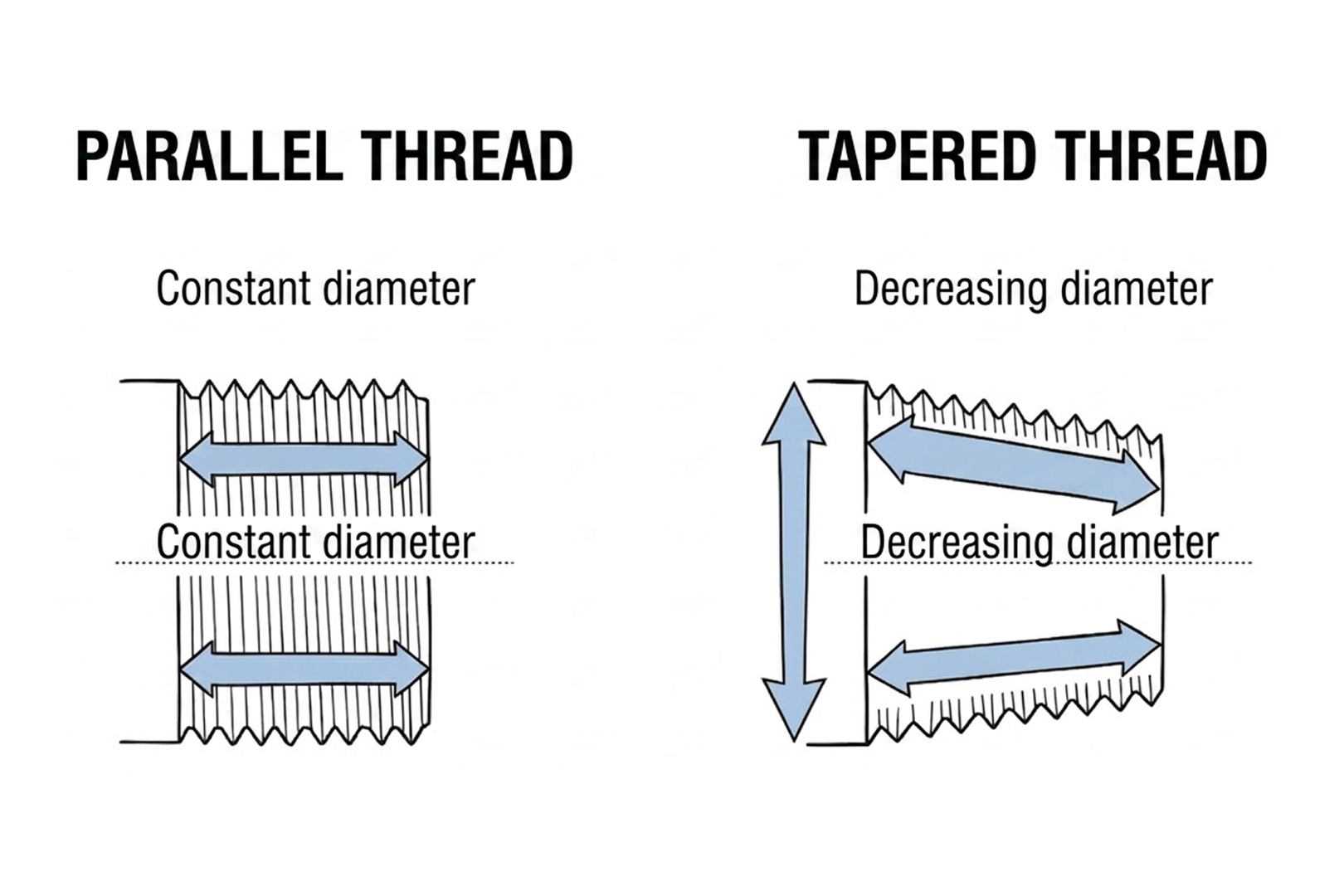
BSP stands for British Standard Pipe and is the designation of a thread standard for pipe threads originating from the UK. Within this system, a distinction is made between parallel threads and tapered threads. Parallel means: the diameter remains constant over the thread length. Tapered means: the diameter changes along the length and becomes smaller in the direction of tightening, as the thread tapers like a cone.
In BSP, the parallel thread is designated as G, the tapered one as R. It becomes technically precise with the standards: ISO 228-1 describes pipe threads where no pressure-tight connection is made within the thread. ISO 7-1 or EN 10226-1 describes pipe threads where pressure-tight connections are created within the thread.
This is exactly why G and R/Rp/Rc are not simply different names for the same thing, but follow different technical principles.
G thread: the parallel pipe thread
The G thread is a cylindrical Whitworth pipe thread with a 55° thread angle. Both internal and external threads are parallel, meaning the diameter remains constant over the entire thread length.
The sealing principle is decisive: G threads are not designed to seal within the thread itself. Sealing always takes place outside the thread, for example via a sealing face, an O-ring, or a flat gasket.
This is exactly where one of the most common sources of error in practice lies. G threads are often mistakenly treated as if they become tight simply by being screwed together. This is technically incorrect and, in case of doubt, leads to leaks.
Typical applications for G threads are therefore connections in which the sealing function is structurally achieved through separate sealing elements, for example fittings with flat sealing faces or integrated sealing systems.
R, Rp and Rc: the system that seals within the thread
R, Rp and Rc belong to the system of thread-sealing pipe threads according to ISO 7-1 or EN 10226-1. Unlike the G thread, the sealing effect here is created directly via the thread flanks.
The designations are clearly defined:
- R stands for a tapered external thread
- Rp for a cylindrical internal thread
- Rc for a tapered internal thread
In practice, the most common combination is R (external) to Rp (internal). When screwed in, the tapered external thread is pressed into the internal thread. This deformation creates the sealing effect in the thread.
Important: Even though these threads are “sealing within the thread,” in practice they are almost always used with sealing compounds such as PTFE tape, thread sealing cord, or sealing paste. These support the sealing effect and compensate for manufacturing tolerances.
Rc as a tapered internal thread is also used, but in practice it is less common than the combination of R and Rp. Appropriate taps are used to produce such internal threads.
NPT: the American standard
NPT stands for National Pipe Thread and is the standard commonly used in the USA for tapered pipe threads according to ASME B1.20.1.
At first glance, NPT appears similar to European R threads, but there are actually crucial differences:
The most important is the thread angle. While Whitworth or BSP threads (G, R, Rp, Rc) use 55°, NPT has a 60° thread angle. In addition, the thread profiles also differ in the shape of thread crests and roots.
This means that NPT and BSP threads are not compatible, even if they look similar at first glance. In practice, this means: mixing these systems leads either to damaged threads or to leaks.
As with R threads, the sealing effect is created by the conical tightening of the thread flanks when screwing in. Nevertheless, NPT is also generally used with sealing compounds such as PTFE tape or sealing paste in order to ensure reliable sealing. External threads are typically produced using dies .
NPTF and NPS: important variants
NPTF (Dryseal):
NPTF is a further development of NPT and is also a tapered pipe thread with a 60° thread angle. The decisive difference lies in the sealing principle: NPTF is designed so that sealing takes place without additional sealing compound through metal-to-metal contact. This is made possible by tighter tolerances and an adapted thread geometry.
NPS (National Pipe Straight):
NPS is the cylindrical variant in the US system. The thread is parallel and does not seal within the thread itself. Sealing takes place – similar to G threads – via sealing faces or O-rings.
| Thread |
| Sealing principle | Standard | Thread angle |
| G | parallel | not in the thread | ISO 228-1 | 55° |
| R | tapered external | in the thread | ISO 7-1 |
|
| Rp | parallel internal | in the system with R | ISO 7-1 |
|
| Rc | tapered internal |
| ISO 7-1 |
|
| NPT | tapered | in the thread (with sealing compound) | ASME B1.20.1 | 60° |
|
NPTF | tapered |
metal-to-metal
sealing (Dryseal)
|
| 60° |
|
| tapered | not in the thread |
| 60° |
Which combinations work?
Not every combination of pipe threads is meaningful or technically correct. This is exactly where most mistakes happen in practice.
- G to G: Mechanically compatible, but sealing takes place not in the thread, but via a sealing face, O-ring, or flat gasket
- R to Rp: The standard combination in the system according to ISO 7 / EN 10226 for thread-sealing connections
- R to Rc: Also an intended combination within the same system
- G external thread in Rp internal thread: Sometimes done in practice, but not a proper standard solution. Without additional sealing, no reliable sealing connection is created here
- NPTF to NPT: mechanically compatible, but the Dryseal principle does not work optimally this way
- NPS to NPT: mechanically possible, but without sealing function in the thread
- Combine NPT with BSP (G, R, Rp, Rc): Not a good idea. Different thread angles and often also different pitches mean that the threads do not engage correctly
A typical example: For 1/4", an NPT thread has 18 threads per inch, while a BSP thread has 19 threads per inch. It looks similar, but technically it does not fit together.
The simple rule: Only combine threads of the same system. Anything else is a risk for leaks or damaged components.
Typical mistakes with pipe threads
- Treating G threads as self-sealing → without an additional seal, this almost always leads to leaks
- Mixing NPT and BSP threads → different angles and pitches → does not fit properly
- Measuring only the outside diameter → incorrect identification, because the inch designation is not a real dimensional value
- Ignoring pitch and thread profile → crucial distinguishing features are missing
- Using incorrect or worn tools (taps, dies) → dimensional deviations and poor thread quality
Why 1 inch in pipe threads is not 25.4 mm
A common misconception: the inch designation in pipe threads is interpreted directly as a dimension. In practice, this regularly leads to confusion.
In pipe threads, the inch designation is not a direct indication of the outside diameter, but rather a historical nominal size from pipe engineering. It originally refers to the approximate inside diameter of pipes, not to the thread itself.
The consequence is: A thread designated G 1 or R 1 does not have an outside diameter of 25.4 mm, but is actually around 33.2 mm.
So anyone who only measures with a caliper and expects “1 inch” to equal 25.4 mm is systematically wrong with pipe threads.
For correct identification, standard tables, thread gauges, and an understanding of the respective thread system are therefore always crucial.
This is how you correctly identify an unknown pipe thread
In practice, the problem rarely lies in what is written on the drawing, but rather in what is actually lying in front of you on the workbench. That is exactly why correct identification is crucial.
-
Check whether the thread is parallel or tapered
Measure the diameter at several points along the thread.
If it remains the same, it is a parallel thread (e.g. G or NPS).
If it becomes smaller in the screwing direction, it is a tapered thread (e.g. R, NPT or NPTF). -
Determine the pitch
You will not get far here with the naked eye. Use a thread gauge to accurately determine the number of threads per inch or the pitch. Especially with similar sizes, this value is often the deciding factor. -
Pay attention to the thread profile
The difference between 55° (BSP) and 60° (NPT/NPTF/NPS) is small, but crucial.
In addition, on Whitworth threads the crests and roots are rounded, whereas on NPT systems they are more flat . -
Assign the system and standard
Only when geometry, pitch, and profile all match can you clearly assign the thread to a system. Before that, any assumption is risky.
The most important rule at the end: Do not guess.
An incorrectly identified thread almost always leads to damaged components or leaks.
Conclusion
Distinguishing between pipe thread types is not a detail, but the basis for functioning connections. G stands for a parallel thread without sealing function in the thread, while R, Rp and Rc stand for thread-sealing systems according to ISO 7. NPT and NPTF are the American variants with tapered thread and 60° thread angle, whereby NPTF as a Dryseal version can also seal without sealing compound. NPS complements the system as a parallel US pipe thread without sealing function in the thread.
Anyone who clearly understands these differences avoids typical errors such as incorrect combinations, leaks, or damaged threads. What always matters is the interaction of thread shape, pitch, profile, and standard.
In short: it is not the abbreviation alone that decides, but the system behind it.
At VÖLKEL, you will find the right taps and dies for all the pipe thread types mentioned. In addition, for selected thread types such as G and NPT, we also offer the appropriate thread gauges .
FAQ: Frequently asked questions about pipe threads
Are G and Rp the same?
No. Even though both threads are cylindrical (parallel), they belong to different systems.
G belongs to ISO 228-1 and does not seal in the thread.
Rp belongs to ISO 7 / EN 10226 and is part of a system in which the sealing effect is created in the thread
What is the difference between NPT and NPTF?
Both are tapered pipe threads with a 60° thread angle.
The difference lies in the sealing principle: NPT generally requires a sealing compound, whereas NPTF as a Dryseal thread is structurally designed so that it can also seal without sealing compound.
What is NPS and when is it used?
NPS is a parallel pipe thread according to the US standard. It does not seal in the thread itself, but requires additional sealing elements such as O-rings or sealing faces. It is used wherever a cylindrical threaded connection with external sealing is required.
Can NPT and BSP threads be screwed together?
In short: no.
Different thread angles (60° vs. 55°) and often also different pitches mean that the threads do not engage cleanly with each other. This leads to leaks or damaged components.
What does Rc stand for?
Rc refers to a tapered internal thread in the system according to ISO 7-1. It is typically combined with an R external thread and belongs to the thread-sealing pipe threads.
Why does a 1" thread appear larger than 25.4 mm?
Because the inch designation for pipe threads is a nominal size and does not describe the actual outside diameter. A G 1 or R 1 therefore has a significantly larger diameter in practice.
Matching tools in the VÖLKEL shop: Machine Taps, Round Dies / Hexagon Die Nuts and Thread Gauges.


